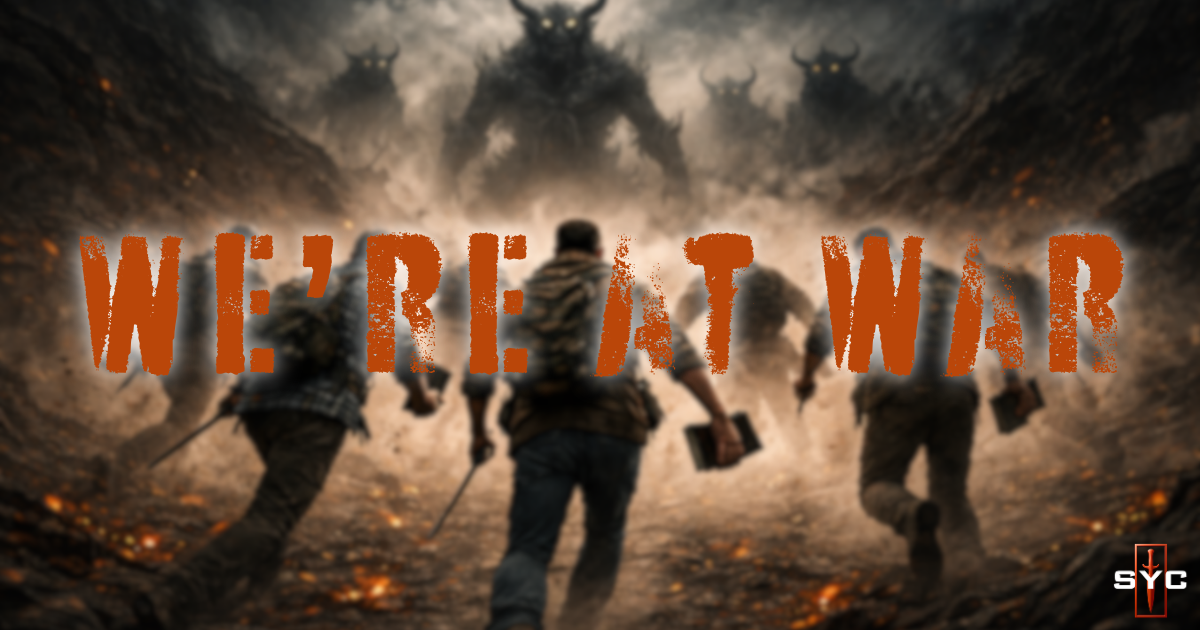
We’re at War
There is a narrative circulating in much of modern Christianity that sounds noble on the surface but hollow at its core. It tells men—especially men—to soften, to quiet down, to avoid confrontation at nearly any cost. It quotes verses about meekness. It points to the Sermon on the Mount. It reminds us that gentleness is a fruit of the Spirit. And all of that is true.
But something subtle has happened.
Meekness has been redefined as passivity.
Submission has been recast as surrender to whatever pressure happens to be applied.
Obedience has been confused with appeasement.
And in that confusion, an essential part of biblical manhood—and biblical Christianity—has been quietly laid aside.
Let’s slow down and ask a harder question.
When we look at Christ, what exactly are we seeing?
We often say He submitted to His captors. We quote Isaiah’s prophecy that He was led as a sheep to the slaughter. We speak of His silence before Pilate as the ultimate picture of meekness.
But who was He submitting to?
Was the Son of God bowing to Rome?
Was He yielding to the Sanhedrin?
Was He surrendering to mob justice?
Or was He submitting to the Father?
In the garden, under the crushing weight of what was coming, He prayed:
“Not my will, but thine, be done.”
That statement changes everything.
Christ was not yielding to the will of wicked men. He was aligning Himself—deliberately, resolutely, unflinchingly—with the will of His Father. His submission was vertical before it was ever horizontal. His obedience was upward before it ever appeared passive outwardly.
And that obedience was not weakness.
It was war.
The Cross Was Not Defeat
We have become so accustomed to seeing the Cross as a symbol of suffering that we forget it is also the decisive battlefield of history.
When Jesus walked toward Golgotha, He was not being overpowered. He had already said no man could take His life from Him—He would lay it down. The arrest, the trial, the scourging, the nails—none of it happened because He was helpless.
It happened because He was obedient.
There is a difference.
What looked like meek surrender was, in reality, the most aggressive offensive against sin and death the world has ever seen. The Son of God stepped into the teeth of hell and absorbed its full fury—not because He was timid, but because He was determined.
He was not submitting to evil. He was crushing it.
He was not yielding to darkness. He was disarming it.
He was not appeasing sin. He was condemning it in the flesh.
That is not passivity. That is conquest through obedience.
And if we misunderstand that, we will misunderstand what we are called to be.
Meekness Is Not Moral Weakness
Biblical meekness is strength under control. It is power restrained for a higher purpose. It is the disciplined refusal to use force for selfish ends—not the refusal to stand at all.
Moses was called the meekest man on earth, yet he confronted Pharaoh. David wrote of trusting the Lord, yet he faced Goliath. Paul urged gentleness, yet he rebuked error boldly and endured prison for the truth.
Meekness is not the absence of backbone.
It is backbone governed by obedience to God.
When submission to earthly authority aligns with God’s will, Scripture is clear—we submit. Not because the authority is perfect. Not because we fear man. But because obedience to lawful authority, in those cases, is obedience to God.
But when human demand contradicts divine command, the pattern shifts. The apostles declared plainly that they must obey God rather than men.
The line is not drawn at comfort.
The line is drawn at obedience to the Father.
And that is exactly what Christ demonstrated.
He did not resist arrest because the Father’s will was redemption.
He will not refrain from judgment when He returns because the Father’s will will then be justice.
The same obedient Son who laid down His life will one day return as the conquering King.
The Conquering Savior
We are comfortable with a suffering Savior.
We are less comfortable with a returning Conqueror.
But both are true.
He first conquered by submitting to the Father’s will to secure our salvation. Through the Cross and Resurrection, He broke the dominion of sin and disarmed the enemy.
Yet Scripture also presents Him as the coming King who will execute righteous judgment. The Lamb is also the Lion. The Shepherd is also the Commander.
Our God is not merely gentle.
He is the Lord of Hosts.
That title means something. It speaks of command, of armies, of sovereign authority over the forces of heaven. It reminds us that the God we serve is not wringing His hands over the condition of the world. He reigns.
And we, in Him, are called kings and priests.
Kings do not abdicate responsibility.
Priests do not abandon intercession.
Warriors do not desert the field.
So why do so many Christian men shrink back?
The Danger of a Softened Gospel
There is a phrase that has been repeated so often it has become almost unquestioned: “Be a gentleman.”
On its surface, there is nothing wrong with courtesy. There is nothing wrong with kindness. But somewhere along the way, gentleness became equated with disengagement. Strength became suspect. Boldness became abrasive.
And manhood was slowly trimmed down to something safe, non-threatening, and culturally compliant.
That is not biblical meekness.
That is domestication.
The culture does not mind a quiet Christian so long as he does not challenge its idols. It does not object to a soft-spoken believer who keeps his convictions private and his sword sheathed.
But Scripture does not describe a church at leisure. It describes a church at war.
We wrestle not against flesh and blood. The enemy is not political. It is not merely social. It is not confined to personalities or headlines. It is spiritual. It is organized. It is relentless.
And pretending otherwise does not make it go away.
We are at war.
That does not mean we rage against people. It means we recognize the spiritual reality behind the visible world. It means we stop living as if neutrality is possible.
The battlefield runs through our homes.
Through our churches.
Through our own hearts.
And no soldier walks onto a battlefield unarmed by design.
Sell Your Garment (Cloak) and Buy a Sword
When Christ told His disciples that the days ahead would be different, He made a striking statement: if they lacked a sword, they were to sell their garment and buy one.
That verse has been argued over, debated, softened, spiritualized, and contextualized. But whatever else it means, it does not mean this: it does not mean that the days ahead would be easier.
He knew persecution was coming. He knew hardship would follow. He knew the comfort of walking beside Him physically would soon be replaced by the responsibility of carrying the mission forward.
Preparation was not a lack of faith.
It was obedience.
And that principle still stands.
We cannot fight unarmed and ill-prepared.
The weapons of our warfare are not carnal—but they are real. Truth is a weapon. Righteousness is armor. Faith is a shield. The Word of God is a sword.
But those are not abstract concepts. They require discipline.
Study your Bible. Not casually. Not occasionally. Study it. Wrestle with it. Memorize it. Pray over it. Ask the Spirit to reveal truth and expose error. Let it shape your mind so that you can discern what is false when it appears in attractive clothing.
Train your spirit.
But do not neglect the physical responsibilities God has entrusted to you either. If you are called to protect your family, then take that calling seriously. Train your body. Strengthen your mind. Develop awareness. Prepare, not out of fear, but out of stewardship.
Train your hands.
Spiritual passivity and physical irresponsibility are not virtues.
They are neglect.
Fortifying Against the Real Enemy
There are two fronts in this war.
The first is external—the pressures of culture, the normalization of sin, the erosion of biblical truth. The second is internal—the flesh. Pride. Lust. Laziness. Fear.
We cannot fortify one and ignore the other.
A man who can articulate doctrine but cannot control his temper is not prepared.
A man who can bench press three hundred pounds but cannot lead his family in prayer is not prepared.
Strength must be whole.
That is what true meekness looks like—strength disciplined by obedience to God. A man who is capable but governed. Bold but submitted to the Father. Courageous yet humble before the Word.
And here is the critical distinction: we do not fight for victory.
We fight from it.
We are more than conquerors—not because we are impressive, but because He has already conquered. The decisive blow has been struck. The enemy’s fate is sealed.
But that does not eliminate our responsibility.
It defines it.
Rejecting False Worship
Throughout history, the people of God have been tempted to blend truth with cultural comfort. Ancient idols had names like Baal and Ashtaroth. Modern idols have different names—success without sacrifice, influence without conviction, safety without courage.
The forms change. The temptation remains.
To give away our roles in the home.
To outsource leadership.
To abdicate responsibility.
To let someone else stand in the gap.
But kings lead the fight.
And priests intercede for their people.
If we have been made kings and priests in Him, then that calling carries weight. It means we cannot afford apathy. It means we cannot live half-asleep while darkness advances.
It means we step into the responsibilities God has assigned—spiritual leadership in the home, courage in the church, integrity in the marketplace, discipline in private.
Not with arrogance.
Not with rage.
But with conviction.
Bringing It Home
This is not a call to aggression for its own sake. It is not an invitation to self-exaltation. It is a summons to alignment with the Father’s will.
Just as Christ did.
He did not seek conflict for ego. He sought obedience for redemption. He did not lash out at His captors because the Cross was the Father’s will. But He will not hesitate to judge when justice is required because that too will be the Father’s will.
The pattern is clear.
We submit to man when it aligns with obedience to God.
We resist when obedience to God requires it.
We never confuse cultural approval with divine command.
So study.
Pray.
Train.
Lead.
Protect.
Repent quickly when you fail. Rise again. Press forward.
The days of casual Christianity are fading. The pressures are increasing. The lines are sharpening. Neutral ground is disappearing.
We are at war.
Not with flesh and blood—but with spiritual forces that will not rest simply because we wish they would.
So let us stop redefining meekness into something small.
Let us see Christ clearly—obedient to the Father, fierce against sin, resolute in purpose.
Let us be governed by that same obedience.
Prepared in Spirit. Ready in Strength.