The 3D-Printed Rabbit Hole — And Why Not to Go Down It
Very shortly after I got a start down the road of a passion for 2A, I went down the 3D-printed rabbit hole.
It seemed like a cool challenge. A technical puzzle. An opportunity to better understand how handguns work, how they’re assembled, and what really makes them function. From a purely mechanical and educational standpoint, I’ll admit—it was interesting.
And yes, I did my homework. After researching the laws in my state, it was clear that manufacturing a firearm for personal use was lawful, so long as I wasn’t selling them or mass-producing them. No intent to distribute. No gray area. Just personal use.
Cool. Box checked.
From there, the process is surprisingly accessible. Files are free and easy to find with a halfway decent Google search. Instructional videos and documentation are everywhere. There are entire websites dedicated to selling upper and lower parts kits so you can assemble the printed frame once it’s done.
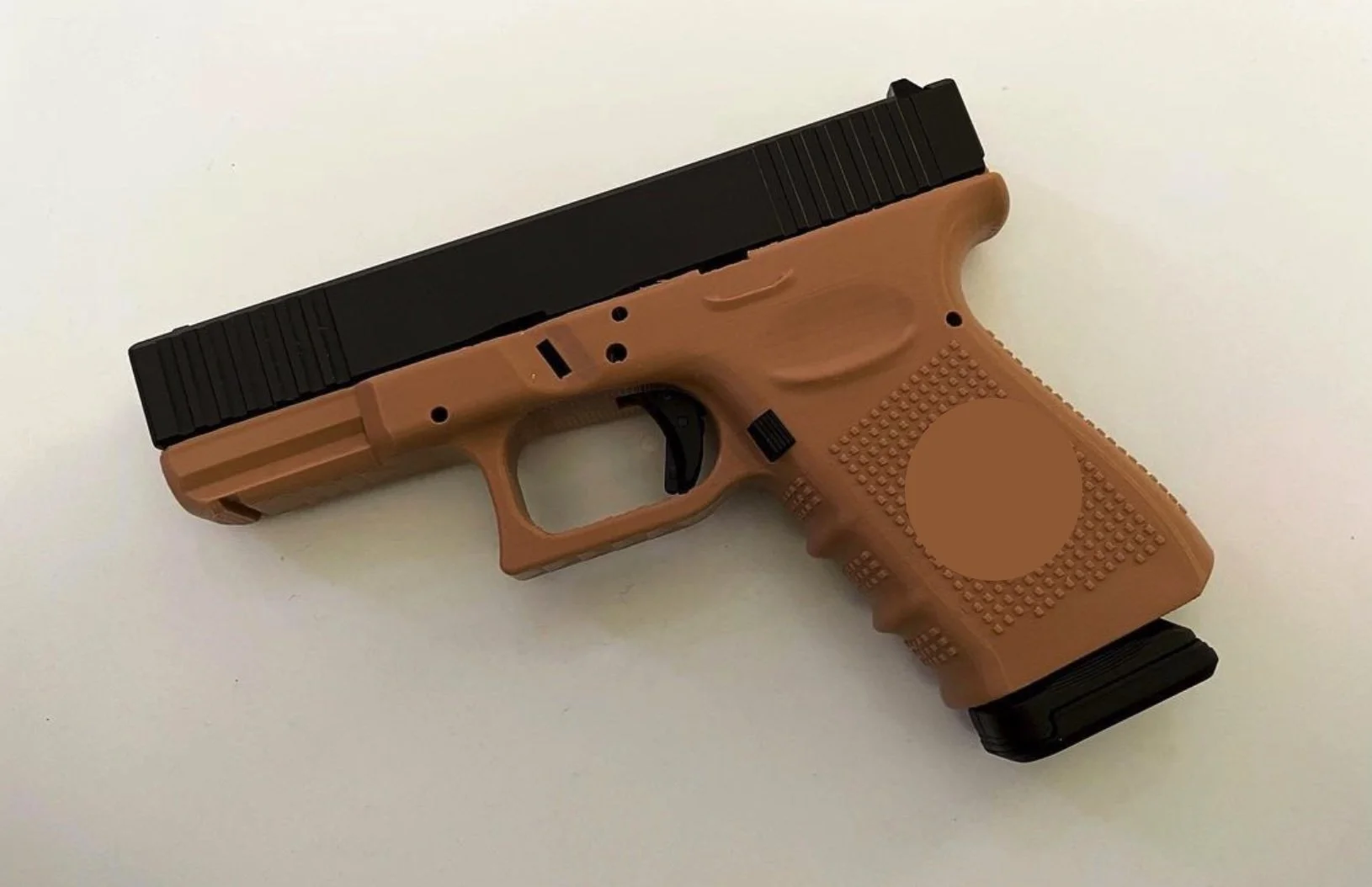
This one is missing some of the lower parts kit, but this is one of the 3D printed frames. This is somewhere in a trash heap busted into pieces before disposal with no hardware left in it. There’s a logo I can’t post on the grip, but think “space western with samurais” and “warrior class” skull logo.
Here’s the reality, though.
What you can’t print are the parts that actually matter—the metal components that control and contain the bang. You still need to buy rails, locking blocks, pins, trigger components, a slide, barrel, sights, recoil assembly… all of it.
In other words, the only thing you’re really printing is the lower frame.
Ironically, that also happens to be the one part the ATF considers “the firearm.”
And that’s where the problems start.
Unless you’re using exactly the right material and your printer is dialed in to an exceptional level—layer adhesion, temperature, orientation, reinforcement—these guns are going to be less reliable than just about anything you can buy from a reputable dealer.
In some cases, they’re not even cheaper.
Sure, the printed frame might cost less than a dollar in filament. But once you add up the parts kits, slide, barrel, rails, and everything else, you’re often right at—or above—the cost of something like a PSA Dagger or a Taurus G3C.
And I’ll say this plainly:
I would trust my life to those long before I would trust it to a 3D-printed firearm.
Matter of fact, I wouldn’t trust my life at all to a 3D-printed firearm.
That realization was the turning point for me.
We have to be realistic about why we own firearms. If you’re not willing to use it in a fight to protect life, then what is the point of owning it? I’ve spent a lot of time preaching a protector mindset, and that means we shouldn’t be owning firearms we don’t train with—or trust—for that purpose.
Once that sunk in, I dismantled every 3D-printed gun I had built. I replaced the printed frames with actual serialized lowers. And those, over time, were replaced again—tenfold—by increasingly reliable, proven firearms.
Every printed frame I had? They ended up in the trash.
If you’re on a budget and looking for a firearm, skip printing altogether.
There are solid, proven options out there:
Palmetto State Armory Dagger
Law-enforcement trade-ins
Ruger RXM
Mossberg’s sub-compact offerings
Taurus (the G3C or GX4 in particular—Taurus has come a long way)
Tisas PX9
SAR9
All of these are budget-friendly, reliable, and supported by real-world track records.
So, to answer the question: “To 3D print or not to print?”
From experience, my answer is a hard and fast no.
It’s a waste of valuable time and money—time and money that would be far better spent on a reliable firearm and training with that reliable firearm.
And when it comes to protecting life, reliability isn’t optional.
Prepared in Spirit. Ready in Strength.